RESEARCH
RESEARCH VISION
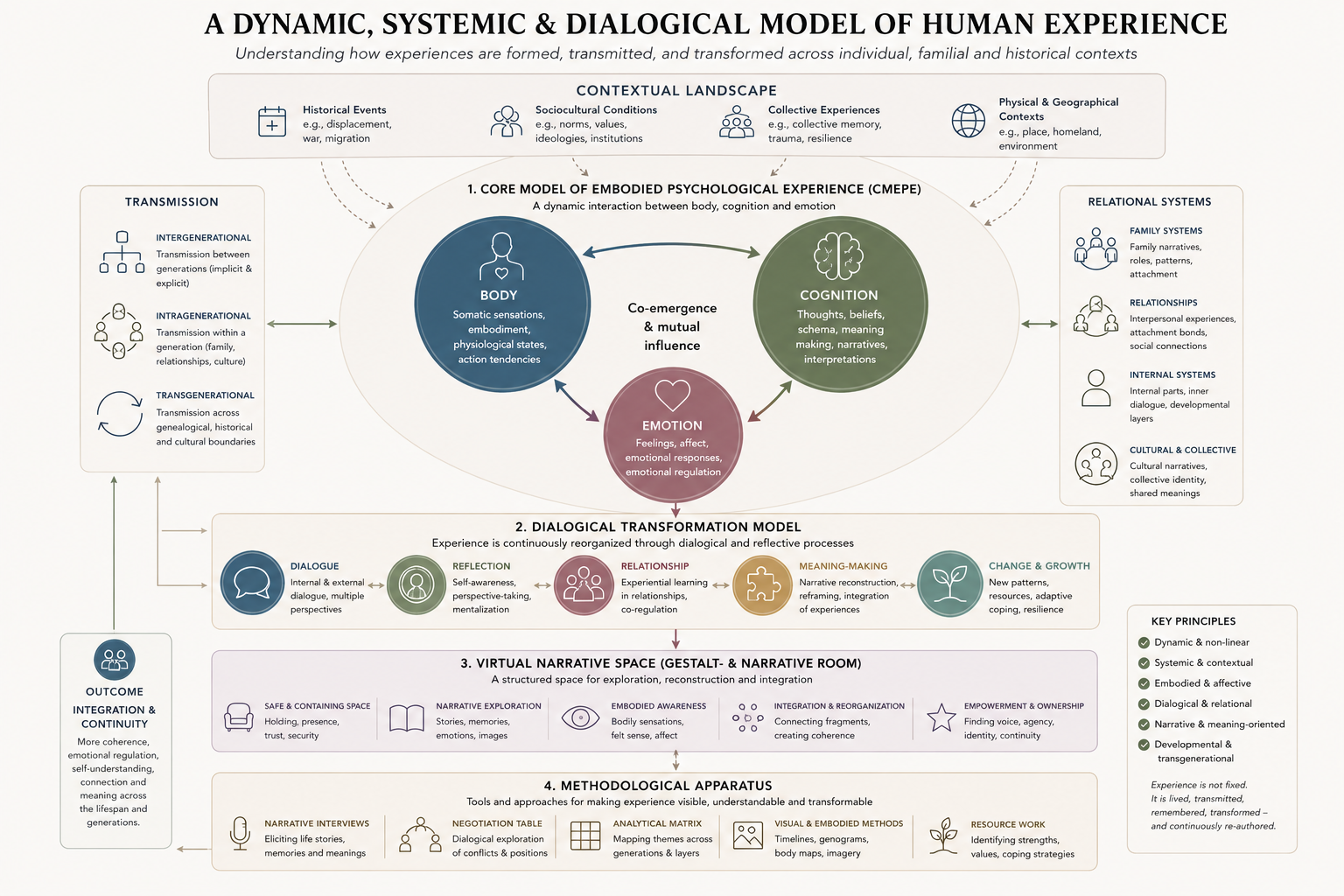
Human experience does not emerge in isolation. It develops through the continuous interaction between body, cognition, emotion, relationships, and the broader historical and sociocultural environments in which individuals and families are embedded.
The long-term vision of this project is to contribute to an interdisciplinary understanding of how experiences are encoded, organized, transmitted, and transformed across individual, familial, and collective contexts.
At the core of this work lies the assumption that body, cognition, and emotion form a dynamic and interdependent system of embodied experience.
This system is continuously shaped by relational experiences, family narratives, collective memories, historical events, and sociocultural conditions. Experiences are therefore understood not as isolated events, but as multilayered processes unfolding across time and generations.
Particular attention is given to:
embodied and affective processes,
intergenerational, intragenerational, and transgenerational transmission,
memory and narrative continuity,
resources and coping strategies,
experiences of displacement, belonging, and homeland loss,
and the dynamic interaction between individual and collective experience.
THE EMBODIED EXPERIENCE FRAMEWORK (EEF)
CONTEXTUAL LAYERS
(History · Culture · Family · Society)
↓
BODY ↔ COGNITION ↔ EMOTION
↓
Dialogue · Reflection · Meaning-Making
↓
Integration · Adaptation · Continuity
Human experience is understood as a dynamic interaction between body, cognition, and emotion, embedded within relational, historical, and sociocultural contexts. Through dialogue, reflection, and meaning-making, experiences can be reorganized, integrated, and transformed across time and generations.
CURRENT PROJECT
Intergenerational Transmission, Memory, and Narrative Continuity in Families Affected by Historical Displacement (1945–1950)
This research investigates how experiences of displacement, homeland loss, emotional responses, and coping strategies are transmitted and transformed across generations.
By examining narratives, relational patterns, resources, and processes of remembrance, the project seeks to better understand how individual and collective experiences are integrated within family systems and how they continue to shape meaning-making, resilience, and identity across time.
The aim of my work is to support the development of a body that feels like home —
a place of stability, orientation, and inner coherence.
It is both a space of creation and a space of strength through dialogue and language:
where inner processes can be explored, and resilience can be built.